

Under an amendment to the Planned Areas Zoning Regulation published in the Official Gazette, issue No. 32838 of 11 March 2025, rainwater harvesting and greywater systems became mandatory for new buildings of a certain size. These provisions entered into force on 1 January 2026. The question most often asked by people planning a villa in Muğla is: does this requirement apply to my project?
Which buildings require a rainwater system?
Under the regulation, a rainwater harvesting system is mandatory where the required tank volume exceeds 7 m³ in the following buildings:
- Buildings on plots larger than 2,000 m²
- Buildings with a total roof projection area on the plot exceeding 1,000 m²
- Public buildings requiring a tank volume above 7 m³

The tank volume is determined in accordance with TS EN 16941-1 so as to cover at least 6% of the annual collectable rainwater, calculated from the province’s average annual rainfall and the roof’s surface type and projected area.
Where can the collected water be used?
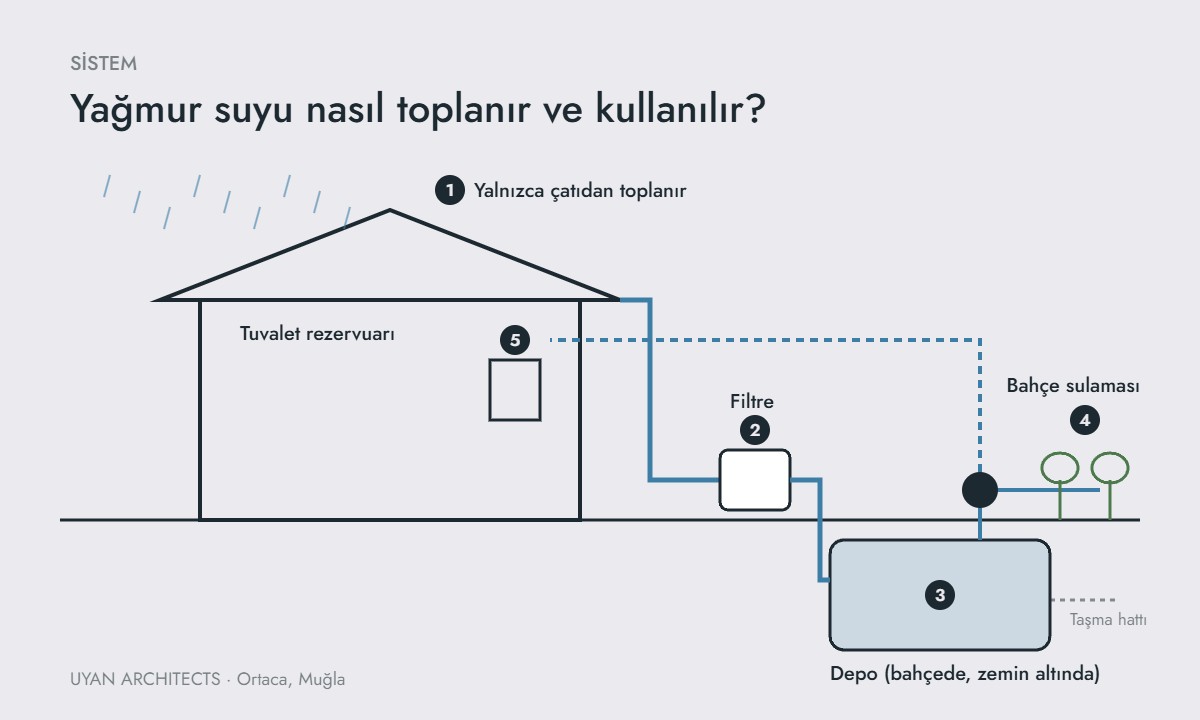
Rainwater may be collected only from roof surfaces and used only for garden irrigation or toilet cisterns. Tanks may be located inside the building, above or below ground in the garden provided setback distances are respected, and in the front garden only underground and no closer than 2 metres to the road. The tank overflow is connected to the stormwater network where available.
Greywater system
Treating lightly used water from showers, baths and washbasins (greywater) for use in toilet cisterns is mandatory only in these large buildings: accommodation buildings with more than 200 beds, shopping centres with a construction area over 10,000 m² and public buildings with a construction area over 30,000 m². Detached villas are not covered.
Is your villa within the scope?
On a typical villa plot, the roof projection area usually stays well below 1,000 m². In rural parts of Muğla, however, large plots exceeding 2,000 m² are common. On such a plot, reaching the second condition of a 7 m³ tank volume is not difficult either.
As a rough example: where annual rainfall is 1,000 mm, around 120 m³ of water can be collected each year from a 150 m² roof, and 6% of that is about 7 m³. So even a medium-sized villa on a large plot can come close to the threshold. The exact assessment depends on a calculation to the standard using your project’s roof area and local rainfall data.
The requirement does not apply to:
- Buildings whose permit application was submitted before 1 January 2026
- Other new buildings on a plot that already had a permitted building before that date
- Major alterations to buildings that already hold a permit
Worth considering even if not mandatory
Summers in Muğla are long and dry, and garden irrigation accounts for a large share of a villa’s water use. A tank that collects winter rainfall can reduce reliance on mains water for irrigation. When the tank’s location, capacity and plumbing connections are planned at the start of the project, it costs far less than adding it later.
If you are planning a villa or residential project in Muğla, you can explore our turnkey villa service or get in touch with us.
This article is for information purposes only. For your specific project, refer to the current text of the regulation and the relevant municipality.
Leave a Reply